
In today’s digital-first world, data centers are the backbone of cloud computing, AI workloads, and enterprise IT operations. With increasing demand for uptime, efficiency, and real-time visibility, SCADA (Supervisory Control and Data Acquisition) systems have become a critical component in modern data center infrastructure. This blog explores the role of SCADA in data center monitoring and control, its benefits, and why it is essential for building reliable, scalable, and intelligent facilities.
What is SCADA in Data Centers?
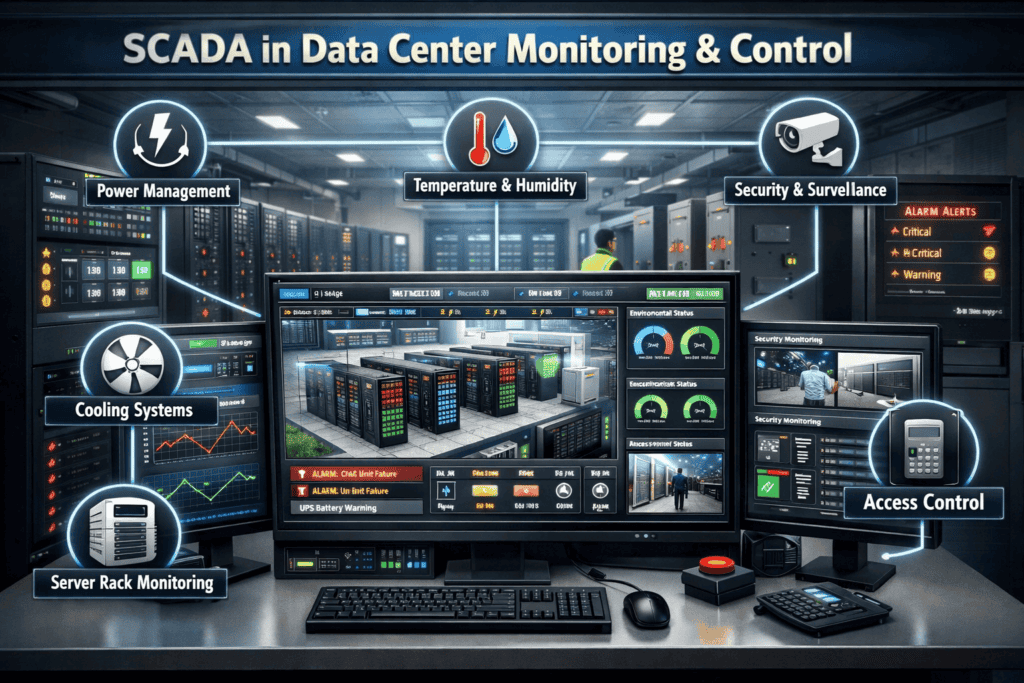
SCADA is an advanced control system used to monitor, analyze, and manage industrial operations in real time. In data centers, SCADA integrates with electrical, mechanical, and environmental systems to provide centralized control and automation.
It collects data from sensors, PLCs (Programmable Logic Controllers), and intelligent devices, enabling operators to monitor performance and respond quickly to any anomalies.
Why SCADA is Essential for Data Centers?
Modern data centers operate 24/7 and support mission-critical applications. Even a minor failure can lead to significant financial and operational losses. SCADA systems help mitigate these risks by offering:
Benefits of SCADA in Data Centers
SCADA for AI-Ready and High-Density Data Centers
With the rise of AI workloads and high-density racks, data centers require more advanced monitoring and control systems. SCADA enables:
This makes SCADA a key enabler for next-generation, AI-ready data centers.
Conclusion
Data Center Automation , SCADA systems play a crucial role in data center monitoring and control, offering real-time visibility, automation, and enhanced reliability. As data centers evolve to support AI, cloud computing, and high-density workloads, the importance of SCADA will continue to grow.
Investing in a robust SCADA solution is not just a technological upgrade—it is a strategic step toward building efficient, resilient, and future-ready data center infrastructure. Contact us Data Center Investment In India