
Supervisory Control and Data Acquisition (SCADA) plays a vital role in modern power systems by enabling real-time monitoring, control, and automation of electrical networks. As power grids become more complex and demand for reliable electricity increases, SCADA systems have become essential for efficient power system operations.
What is SCADA in Power Systems?
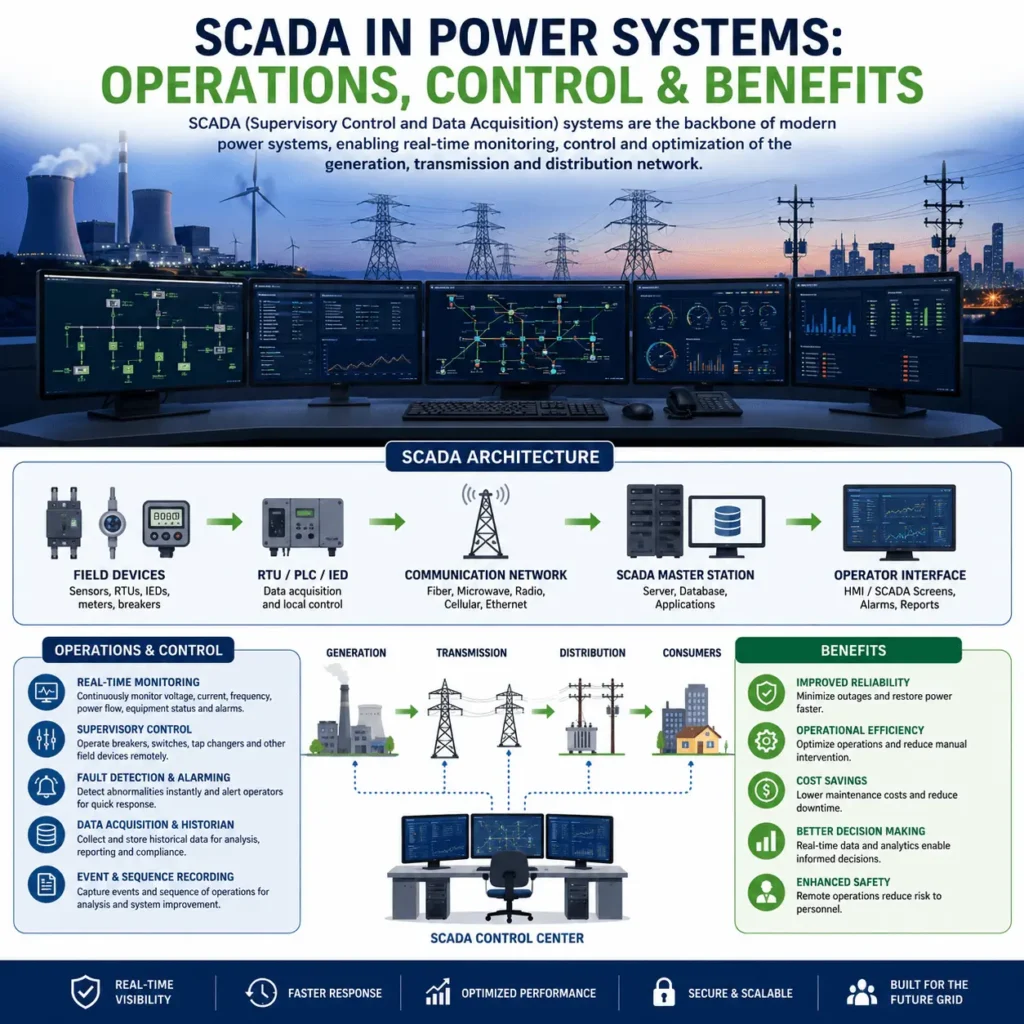
SCADA (Supervisory Control and Data Acquisition) is an advanced control system used to monitor and manage electrical infrastructure such as substations, transmission lines, and distribution networks. It collects real-time data from field devices and allows operators to control equipment remotely.
In power systems, SCADA acts as the “central nervous system,” ensuring seamless communication between control centers and electrical assets.
Key Components of SCADA Systems
A SCADA system in power operations consists of several critical components:
SCADA in Power System Control
Control is one of the most critical aspects of SCADA in power systems. It ensures stable and efficient operation through:
Automatic Generation Control (AGC) – Maintains system frequency and power balance Voltage Control – Regulates voltage levels to ensure safe operation Switching Operations – Enables safe opening and closing of electrical circuits Alarm Management – Alerts operators during abnormal conditions
Benefits of SCADA in Power Systems
Implementing SCADA systems offers several advantages:
Applications of SCADA in Power Industry
SCADA is widely used across various segments of the power industry:
Future Trends in SCADA for Power Systems
With advancements in technology, SCADA systems are evolving rapidly:
Conclusion
SCADA systems are the backbone of modern power system operations and control. By enabling real-time monitoring, automation, and efficient management of electrical networks, SCADA ensures reliable and uninterrupted power supply.
As power systems continue to evolve, adopting advanced SCADA solutions will be key to achieving smarter, safer, and more efficient energy infrastructure.