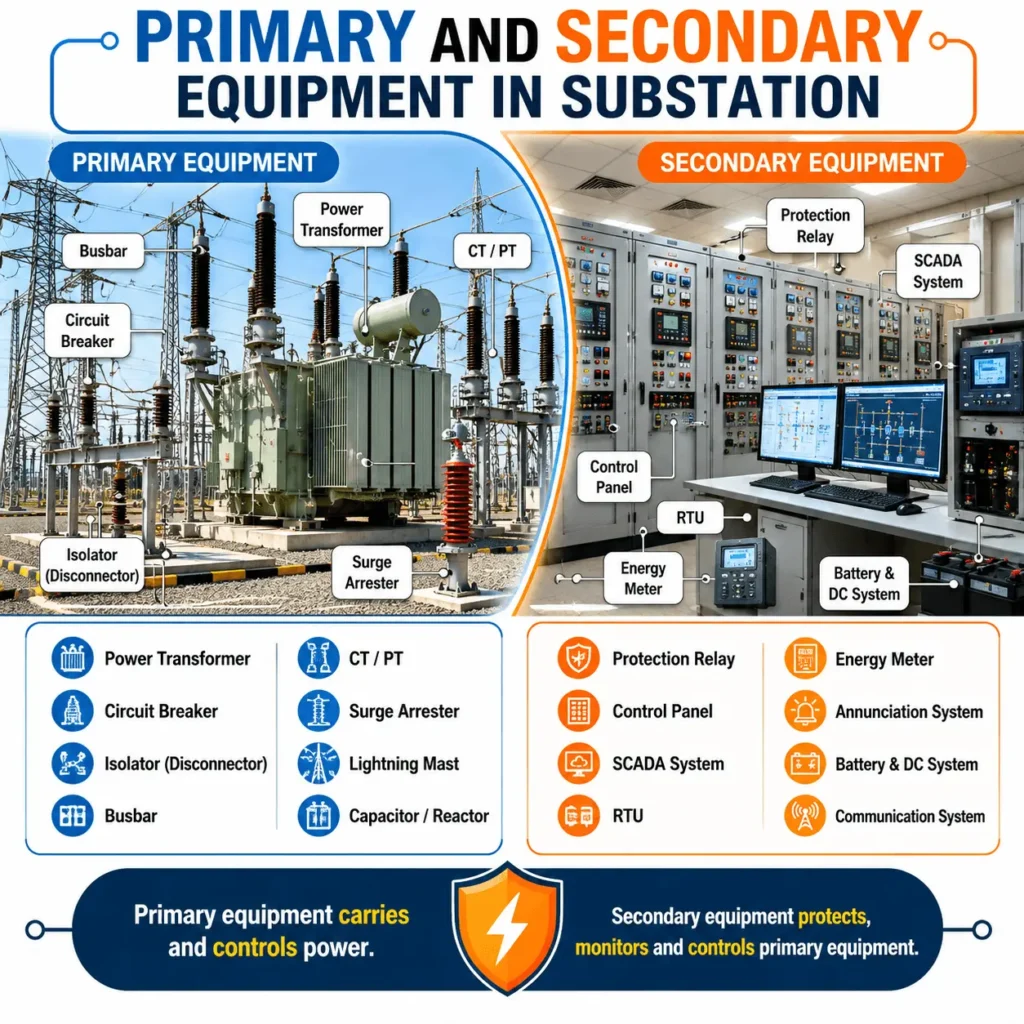
Primary and Secondary Equipment in Substations: Functions, Differences, and Importance
Substations play a critical role in the generation, transmission, and distribution of electrical power. They are responsible for controlling voltage levels, protecting equipment, and ensuring reliable power delivery to consumers. A substation consists of various components that can be broadly categorized into Primary Equipment and Secondary Equipment.
Understanding the differences between these two categories is essential for engineers, technicians, and organizations involved in power system design, testing, commissioning, and maintenance.
What is Primary Equipment in a Substation?
Primary equipment refers to the components that directly carry, switch, transform, or interrupt electrical power. These devices are connected to high-voltage circuits and handle the actual flow of electrical energy.
Common Primary Equipment
1. Power Transformers
Power transformers are used to step up or step down voltage levels for efficient transmission and distribution of electricity.
2. Circuit Breakers
Circuit breakers interrupt fault currents and protect electrical equipment from damage caused by short circuits or overloads.
3. Disconnectors (Isolators)
Disconnectors provide visible isolation of equipment during maintenance activities and are operated under no-load conditions.
4. Current Transformers (CTs)
CTs reduce high currents to measurable values for protection relays and metering systems.
5. Voltage Transformers (VTs) / Potential Transformers (PTs)
These devices reduce high voltage levels to safe values for monitoring, metering, and protection applications.
6. Surge Arresters
Surge arresters protect equipment from lightning strikes and switching surges.
7. Busbars
Busbars collect and distribute electrical power among various circuits within the substation.
8. Capacitor Banks and Reactors
These devices help improve power factor, voltage regulation, and system stability.
What is Primary Equipment in a Substation?
Secondary equipment includes devices that monitor, control, protect, and automate the operation of primary equipment. They do not carry the main power flow but ensure safe and efficient operation of the electrical network.
Common Secondary Equipment
1. Protection Relays
Protection relays detect abnormal conditions such as faults, overloads, and voltage fluctuations and initiate tripping commands.
2. Control Panels
Control panels provide operational interfaces for controlling and monitoring substation equipment.
3. SCADA Systems
Supervisory Control and Data Acquisition SCADA systems enable remote monitoring and control of substations.
4. RTUs (Remote Terminal Units)
RTUs collect field data and communicate with control centers.
5. Energy Meters
Energy meters measure electrical parameters and energy consumption for monitoring and billing purposes.
6. Annunciation Systems
These systems provide alarms and indications during abnormal operating conditions.
7. Communication Equipment
Communication devices support data exchange between substations and control centers.
8. Battery Chargers and DC Systems
These systems provide uninterrupted power supply for protection and control equipment.
Difference Between Primary and Secondary Equipment
| Parameter | Primary Equipment | Secondary Equipment |
|---|---|---|
| Function | Carries and controls electrical power | Monitors, protects, and controls primary equipment |
| Voltage Level | High Voltage | Low Voltage |
| Direct Power Flow | Yes | No |
| Main Purpose | Power transmission and distribution | Protection, control, and automation |
| Examples | Transformer, Circuit Breaker, CT, PT | Relay, SCADA, RTU, Control Panel |
| Failure Impact | Direct interruption of power flow | Loss of protection and monitoring capabilities |
Primary and secondary equipment work together to ensure the safe, reliable, and efficient operation of electrical substations. While primary equipment handles the actual transmission and distribution of electrical power, secondary equipment provides protection, monitoring, control, and automation functions. Understanding their roles and differences is essential for effective substation design, operation, maintenance, and commissioning.
As modern substations continue to evolve toward digitalization and automation, the integration of advanced secondary systems with robust primary equipment remains the foundation of a reliable power grid.